


Madrassas in Pakistan


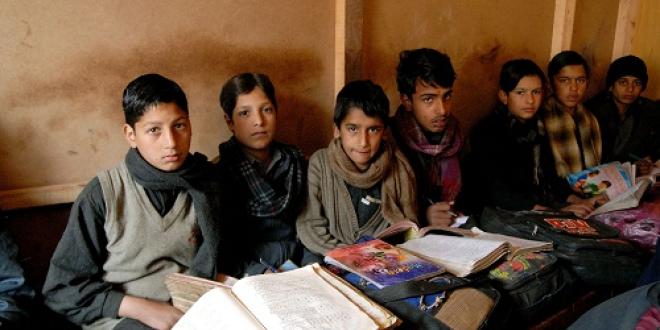
Madrassas are religious institutions shaped to teach mainly Islamic education. They run parallel to the public and private schools and are well spread in the whole of Islamic world.
Back in the 11th century, when the concept of a madrassa came into being, its main purpose was to promote religious awareness and produce future Islamic religious scholars (Ulema). Around the 18th century, a curriculum known as Dard-i-nizamia became the standard syllabus. It tried to combine religious education with rational sciences so that students have the choice of professions like lawyer, administrator, etc. However, madrassas have always concentrated mainly on Islamic education and so the students mostly become religious scholars, preachers etc. But words like fundamentalism, radicalism and terrorism had no or little connection to them in the past.
So what happened in the last three decades that made these religious institutions a target of worldwide criticism? Here we will talk only about the madrassas in Pakistan. Since late 1970's, Pakistan had to undergo a series of events that had a very huge and detrimental influence on these institutions. It started with the Zia UlHaq's "Islamic" regime, then obviously the soviet invasion of Afghanistan and Pakistan's involvement in it, The Iranian revolution and the continuous unchecked support of foreign donors, especially Saudi Arabia.These events changed the main ideology of many madrassas. The teachings became more fundamentalist and extremist in nature, the need to jihad against non-Muslims became the main purpose for many madrassas and sectarian hatred intensified.
The madrasa system in Pakistan is organized through five boards of varying ideologies and each kind has its own educational policy and curriculum. It might be relevant to mention here that unlike Pakistan, in Saudi Arabia, Kuwait, Jordan, Iran, the state controls religious learning to prevent sectarian disharmony in society (tribune)
According to BBC News, there are about 17,000 madrassas in Pakistan providing free religious education to children and a total of around 2 Million students are enrolled in these madrassas.
The total number of madrassas varies in different reports which are mostly based on research done by using nonscientific tool. Also, there is a problem of unregistered madrassas as based on a report by the Criminal Investigation Department (CID) in January 2011, there are 736 unregistered madrassas operating in Karachi alone!
Before I talk about the debate of "Good and Bad madrassas" and the need for reforms related to them, it is important to mention the inadequate and contradictory data available on the religious institution of Pakistan.
While this topic has received widespread media coverage and has been a part of many global discussions and reports, still the research is based on observable accounts and anecdotes. There is an urgent need for the government to start conducting comprehensive surveys and research, so that, rather than having to rely upon other people's and organization's biased opinions and reports, they have sufficient and reliable information of their own regarding the demographics, quantity and quality of religious institutions in Pakistan. The time has come that we shift towards evidence-based policymaking for which high quality data is essential.
We need to have a clear idea about what is actually happening in these madrassas, their financial situation, curriculum and also the views of people controlling and residing in thesemadrassas etc. This will allow us not to come under the pressure of foreign allegations and will enable Pakistan to develop independent policies which truly aim to provide benefit for the whole of the society.
Actual number of Madrassas and their total enrollment rate have always been point of contention among the scholars. This corroborates our above mentioned problem of insufficient data.
A report by the International Crisis group in 2002 on Pakistani madrassas claimed, in its original version, that one third of Pakistani children attend Madrassas. This was later changed but there were quite a few reports that exaggerated the actual number. In 2005, a controversial study by the World Bank, that looked at religious school enrollment in madrassas (PDF), showed that the actual no of children going to the madrassas in less than 1% of the total enrollment in the country. But even this study's research methodology was widely criticized.
Now coming back to the various roles of Madrassas in our society, we cannot deny that madrassas do play a positive role in the society. Not all madrassas propagate extremism and violence; they play a significant role in promoting religious awareness and social improvements among Muslims. They provide thousands of poor children with free food and shelter. And I am sure there are many stories like the personal story told by Professor Ebrahim Moosa1, who himself was educated in several Indian madrasas and is now a successful professor of Islamic Studies at Duke University.
In his article, Redeeming Pakistan's madrassas, Professor SaleemH.Ali said, "…the radicalization of madrassas should not lead us to give up in despair. In other parts of the world, madrassas have served an appropriate educational purpose. For example in West Bengal, India, a survey of Islamic schools in January 2009 found that because of the higher quality education at madrassas, even non-Muslims were actively enrolling in them".
So there are madrassas that serve as pure educational institutions. A good example of such a madrasah in Pakistan is the Jamia Binoria Madrassa 2, in downtown Karachi. One of the most moderate Islamic Institution, Jamia Binoria is a well reputed madrassa that teaches not only Islamic education but also a wide variety of secular subjects too.
But unfortunately, there is little doubt that some fundamentalist religious institutions of Pakistan are involved in activities like terrorism etc. There are many instances when theirconnection to international terrorism and sectarian violence has been exposed to the world.The studies done by Proffesor Saleem H. Ali also confirm the connection of some Pakistan madrassas with sectarian violence and international terrorism. Another report, in 2007, by the United Nations Assistance Mission in Afghanistan found that suicide attackers in Afghanistan "draw heavily from madrassas across the border in Pakistan." There are other incidences too that indicate towards extremism and radicalism prevailing in madrassas of Pakistan. For example in his report, Peter W. Singer claimed that around 10-15% of madrassas have been "hijacked by terrorists".
It is obvious that many foreign scholars and reports have used biased and exaggerated statistics but still no one can deny that some of Pakistani madrassas are exploiting and brainwashing their students for selfish and harmful objectives. There are numerous cases of torture, rape, violence and terrorism connected to madrassas in 2011 alone. (tribune)
The religious institutions are funded by voluntary charity by local people mainly in the form of Zakat, by foreign donors and by the Government of Pakistan for the purpose of modernizing the curriculum.: According to a Special Branch analysis, reported in The News, "74 percent of the funding for these madrassas come from foreign sources, in Pakistani Punjab alone, while only 34 percent come from the Zakat funding."
Main foreign donors include Saudi Government which is said to help the Ahl-i-Hadith seminaries and the Iranian government that supports the shia group.Vali Nasr, an authority on Islamic fundamentalism, views Saudi donations as mainly responsible for funding the terrorist activities. Seeing all this, it is clear that there is a need for reforms regarding the religious institutions of Pakistan. The government did make some policies but unfortunately, due to the pressure of religious groups, fear of rebellions, need for religious groups support and lack of administration, the implementation remained very low and insubstantial.
In 2002, General Parvez Musharraf tried to formulate some policies but according to a report by the International Crisis Group, Musharraf's government made key pledges regarding madrassa reforms but failed badly.One of his pledge was to create model madrassas all over Pakistan that would provide modern, useful education and not promote extremism. Only 3 model Madrassas were established in Karachi, Sukkur and Islamabad in his era!!!
Till now, Pakistan government has tried to look into the problems of unregistered madrassas, non-uniform curriculums and unrestricted autonomy to madrassa stakeholders but effective policies are still missing. No substantial change has been seen and so revision of policies has become a crucial necessity!
Madrassas have a long and significant history in the Muslim world. Thousands of children are being educated there and are provided with free food and shelter. It is not possible physically and ethically to remove them from the face of the earth. So, the government should focus on modernizing and improving these madrassas rather than eliminating them. As professor Saleem H. Ali says, "Although some of the radical madrassas will still need to be weeded out, embracing Islamic education with an integrated reform strategy is more likely to reduce militancy, rather than lamenting madrassas as arcane institutions".The education policy (1998-2010) of Pakistan also seeks to "evolve an integrated system of national education by bringing religious institutions and modern schools closer to each other in curriculum and the contents of education."
So, relevant policies might include: Initiating a dialogue with the religious parties, preventing military training, removing weapons, regulating the funding and reforming the curriculum and integrating the madrassas into main stream education. But as mentioned earlier, before the government formulates its policies, there is a dire need for valid and authentic data regarding these madrassas. Otherwise, misallocation of resources and ineffective policies will result. Foreign perceptions and local opinions are not enough. We need to see the situation from the side of stakeholders of these institutions too. Questions like what is actually happening inside the madrassas, teacher student relationships and views of stakeholders about the government are needed to be answered by carrying out proper surveys and case studies. Only then the government will be able to truly understand the nature of this detrimental growth of religious institutions and to take effective steps for rectifying this situation.